

This Week’s Question: When I do a search on Google my site doesn’t come up. Should I buy the paid ads?
Google Ads

How Much Should You Spend on Google Adwords?
The blessing and the curse of PPC marketing campaign is that you can spend whatever amount you want. Google Adwords lets you set your maximum budget, with no minimum daily ad spend. So if you want to spend exactly $823.47 a month and not a penny more, you can. So the real question is: how much should you spend on Google Adwords campaign?

PPC Advertising: What Is It and How Does It Work?
If you’re new to PPC marketing, it can be confusing to figure out exactly what someone means when they say “PPC.” Even if you’re already doing PPC marketing, knowing how the process works helps you understand your costs and how to get the most out of your investment. Let’s dive in!
What is PPC Marketing?
Pay-per-click is an online advertising model where, like it sounds, you pay every time someone clicks on one of your ads. PPC marketing is a paid alternative you can use to drive more traffic to your site, versus relying only on organic traffic.
Many different sites use a PPC marketing model, including Facebook, Twitter, LinkedIn, Bing, Yelp, Amazon and more. But when most people think of PPC advertising, they think of Google display ads, which is the most common platform.
In fact, Google captures a whopping 78% of the US search ad revenue. Each PPC marketing platform works slightly differently, but we’ll focus on the biggest fish and talk about how Google AdWords works.
PPC MARKETING on Google Adwords
Google didn’t become the largest PPC marketing system in the world by accident. Adwords gives you an incredible amount of control over where, when, how, and to who your display ads are presented. Not only that, but they have two powerful networks you can use:
The Search Network
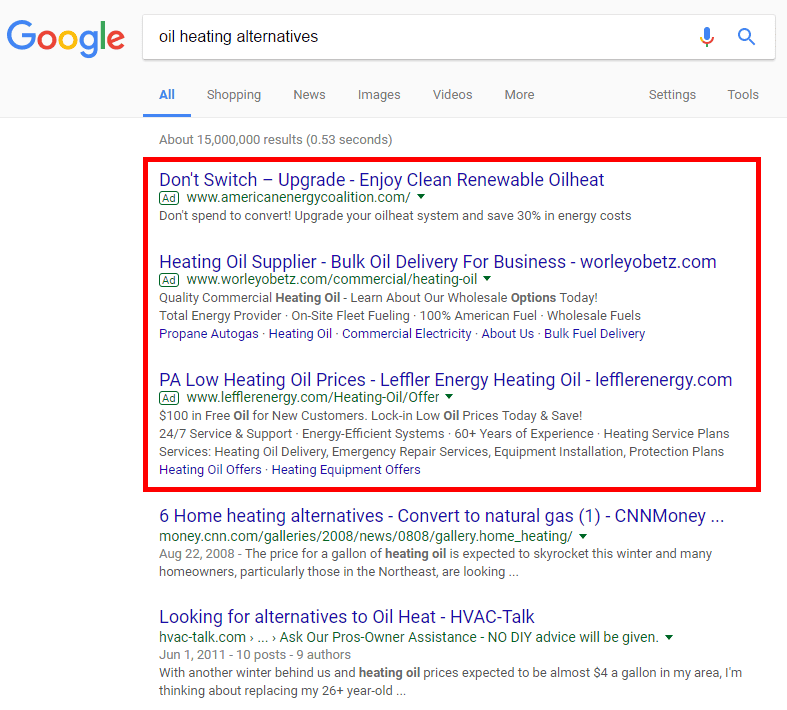
PPC advertising displays on Google’s search engine results page when a user searches for a related topic. Top paid results appear above the normal organic links. (Of the two networks, the search network is normally what people think of first when you say, “Google Adwords.”)
The Display Network
Through the Display Network, you can place banner ads on millions of websites, news pages, and blogs across the internet. According to Google, the network includes over 2 million sites, reaching 90% of global internet users.

Both networks fall under the Adwords umbrella, but you shouldn’t assume that the same ad will work equally on both networks. On the Search Network, users have a need and they are actively searching for information, products, or services to meet that need. They’re likely further along in the buying cycle.
In contrast, Display Network ads are reaching people who are on other sites and may not be looking for your product or service at all. Banner ads are by nature interruptive. They succeed when they are relevant enough and compelling enough to get someone to stop doing what they’re doing to click the ad.
How DoES PPC ADVERTISING Work?
While there are some variations between the Search and Display networks, both work essentially the same way.
First, you determine relevant keywords related to your product or service. Then, you determine a cost-per-click that you bid on those keywords.
The instant when a user performs a search, Google decides if your keywords are relevant to the search query. If so, the Ad Auction begins, where Google compares your ad against similar ads from your competitors.
The Ad Auction
The Ad Auction decides your Ad Rank, which determines where (or if) each ad appears. The advertiser with the highest ad rank gets placed first.
Ad Rank = Max CPC Bid x Quality Score
Ad rank is determined by multiplying your maximum cost-per-click bid by your ad’s Quality Score. Quality Score is Google’s rating (on a scale of 1-10) of how relevant and valuable your ad is. Google keeps the exact formula a mystery, but we know the key factors include:
- Click-through rate
- Landing Page quality
- Relevant keywords
- Relevant ad text
- Historical Adwords account performance
Thankfully, PPC advertising isn’t just a pay-to-win system. By factoring in quality, you don’t necessarily have to be the highest bidder to grab the top spot. This is good news for small businesses, who can actually out-rank large corporations without paying a fortune.
Let’s say, for example, your CPC bid is $2.00. Your ad Quality Score is 8.
Your Ad Rank = $2.00 x 8 = 16
You’re competing a big corporation who bid $5.00, but their quality score is only 3.
Competitor’s Ad Rank = $5.00 x 3 = 15
Your Ad Rank is higher, so you will rank first, despite the fact that they bid more than twice as much as you. Take that, mega-corporation!
Your Actual CPC
After the Ad Auction, Google compares your Ad Rank with your competitors to determine your actual cost per click.
 Image Source: Wordstream
Good news: your actual cost per click is often less than your maximum bid.
Let’s say you’re Advertiser 1. Even though you’re willing to pay $2.00 for each click, you’ll only be charged $1.61. That’s even less than your competitor is paying for the spot below you!
What’s the lesson here? Your Quality Score is critical to getting a good ROI on your PPC marketing. A better Quality Score will boost your Ad Rank and reduce your cost per click. Increasing your bid will only improve your Ad Rank. So invest the time in developing quality ads and great landing pages – it’s the best way to ensure your PPC marketing is a success.
Want to Know How PPC marketing Can Help Your Business?
Check out our free e-Book: Using PPC to Improve Your Bottom Line. We go into more depth about the benefits of PPC advertising and how to put together a successful PPC marketing campaign. You can always talk to our PPC agency in Lancaster to get even more insights.

How to Run an Incredible PPC Holiday Campaign
The holidays are a make-or-break time for many retailers. It’s the most wonderful time of the year – to ramp up your PPC holiday campaign!

Questions to Ask About PPC
PPC marketing is offered to marketers by the major search engines like Google, Yahoo, and Bing. The most popular search engine to run search ads on is Google since they continue dominate search engine use (although their market share is declining). There are many ways to utilize PPC marketing effectively, so following is a list of questions to ask about your PPC marketing campaigns.
Before we do, though, it would be beneficial to explain what PPC marketing does. At its most basic, PPC advertising allows business owners to advertise their websites in search engine results and on related websites within the Google Display Network. These ads help drive traffic instantly to specific product or landing pages on your site. You bid against others that are using PPC marketing for the same keywords to determine which advertiser’s ad displays higher on the page.
To get an idea of how each search engine display PPC ads, this is how they currently look for the three major search engines:
Google PPC

In this example, PPC advertising efforts dominate above the fold. Most search results do not show any organic results until you scroll down, well below paid advertisements. Google currently uses a yellow “Ad” button to clearly indicate which links are PPC ads, and it displays up to four ads above the organic search results.
Bing PPC
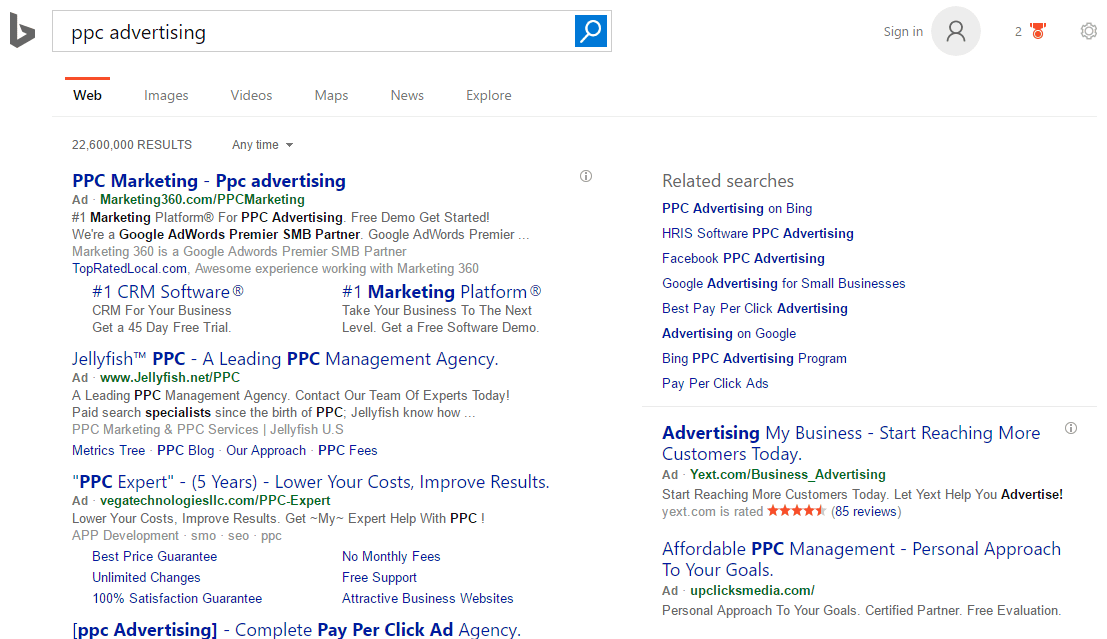
Bing just shows the word “Ad” to the left of the URL, which in this case, is also dominating above the fold with paid results. Bing still shows PPC advertising in the right sidebar, unlike Google, which recently removed its sidebar advertising placements.
Yahoo PPC
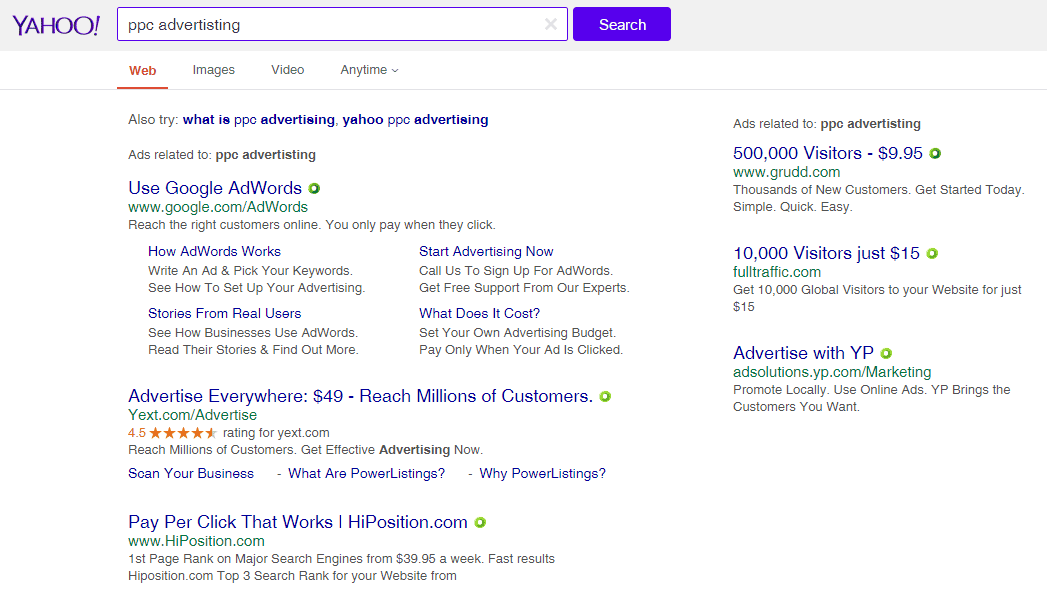
Yahoo shows ads under “Ads related to:” and also shows them in the right sidebar, similar to Bing. As with the other search engines, searches with enough PPC advertising bids dominate the above-the-fold search results over organic results.
Is PPC marketing a short- or long-term strategy?
Depending on the industry, your business, and your cost per lead, PPC marketing can be a short-term strategy. To create and maintain a successful strategy, you need the data to have a successful campaign or you could burn through a lot of money very quickly.
To build a successful PPC marketing campaign, you have to determine at what cost you break even and how many products or services you would have to sell to justify an ROI on ad spend. PPC marketing can be a great long-term strategy because you can turn the campaign on and off as you wish.
As for a long-term strategy, ongoing split-testing with more data can further improve the campaign to enhance your ROI month over month.
Outsourced or in-house PPC management?
There are plenty of horror stories of in-house marketers doing PPC management who are not AdWords Certified (Google’s distinction for those who meet rigorous standards to understand PPC marketing campaigns) or simply have no idea what they are doing. You could easily overspend if you aren’t targeting the right keywords, and filtering out negative keywords as they come in as irrelevant search terms. If you don’t have someone in-house that is certified and experienced in AdWords, then it’s probably a better idea to outsource it or hire someone that is well-practiced.
Without an experienced professional, you may end up with a campaign full of low quality scores. Low-quality ads require your bids to be higher than others just to achieve the same placement. You need to have access to make changes to your website content to help increase low quality scores. So if you also don’t have an in-house web developer, then it is likely something you should outsource.
If outsourcing your PPC marketing campaign, ask the vendor if they are AdWords Certified and/or a Google Partner. If they do not have at least one certified team member, you can filter them out as a legitimate agency offering PPC management as a service. Once you have determined their credentials, ask for an estimated budget and cost per click for certain buyer keywords pertaining to your industry. You want to see whether a campaign will bring you the impressions, clicks, and conversions that you need it to within your budget.
Also, based on the products and services you are selling, ask if it is feasible to earn a positive ROI that justifies a PPC marketing campaign. In a competitive market, if you are spending a lot per click but your campaign doesn’t lead to a big enough margin for profit, it’s probably better to spend your money in other marketing channels.
What are some important PPC MARKETING metrics to understand?
- Quality Score – Gives your ads a score based on quality and relevance, along with the landing page and content that it leads to.
- Click-Through Rate – Not to be confused with conversion rate, your click-through rate is the ratio of clicks to impressions (or how many times your ad displayed versus how many times it was clicked).
- Conversion Rate – How often an interaction with your ad leads to a defined conversion on your site.
- Cost Per Conversion – How much did each one of those conversions cost?
- ROI – Your return on investment – is the cost of each of those conversions still bringing you a profit?
- Call Tracking – Outside of a defined conversion, a call tracking number helps you clearly identify calls that are coming directly from your PPC advertising, and not elsewhere online or from your website.
How do you split-test and optimize PPC marketing campaigns?
To really understand the success of your PPC marketing campaigns, try split-testing keywords with three or so ads in a daily rotation. Take notice of what the CTR, or click-through rate, is for each ad. If it’s lower than 1% on all ads, then you should consider switching them out of the campaign for a better-performing ad. It could be that you are targeting the wrong keywords or just that the ads are under-performing.
If there is an ad that has a higher click-through rate than the other ads, then pause the ads that aren’t converting as much so the best ad is always being displayed. This allows you to maximize your budget while you avoid spending on ads that just won’t perform.
If there are keywords getting irrelevant clicks or that have a higher cost-per-lead conversion rate, then pause those ad groups or remove those keywords too. You need to be filtering out negative keywords so that your ads aren’t showing up and being clicked on for irrelevant searches. If you don’t filter out those irrelevant keywords, than users that click on your ads will bounce from your site. When users don’t find your ads to be helpful or relevant, you can end up with a low AdRank or quality score… not to mention you will be wasting money.
You could also be spending money on ads in the wrong locations, the wrong days of the week, and even at the wrong times of the day. For example, most restaurants generally would want to spend more on advertising over the weekends and less during the weekdays when business tends to be slower.
You should also be taking advantage of extra features like site links, locations markers, tags, clickable phone numbers, reviews, seller ratings, and social extensions. Missing these extensions can result in sub-optimal click-through rates and a poor performing campaign.
Knowing what to ask
If you put forth the right questions – and know the answers that you should be looking for – when running or outsourcing a PPC marketing campaign, your results can only improve. So make sure you know what to ask about PPC marketing: what search engines would be the best fit for your business, an estimate on what you can expect to spend to get to the top of the PPC auctions, if you should do it in-house or outsourced, what you need to break even and see a profit, the metrics you should be paying attention to, and how to continuously split test and optimize your campaign with PPC management. The answers to these questions could result in campaigns that generate a huge return on the investment you’ve made with paid search. Have other questions? Get in touch with our Lancaster PPC agency. We offer a complete array of digital marketing services for small businesses.

Split Testing for PPC – Increase your Conversions and ROI
A strong PPC advertising message is often the difference between visits to your site and a stale PPC marketing campaign. The tone and content of your PPC advertising is the first thing potential customers are confronted with during their customer journey. Regardless of where they fall into your sales funnel, a PPC ad can either seal the deal or direct them to one of your competitor’s sites instead.
When your advertising message is so crucial to PPC marketing campaign success, how do you make your ads stand out among millions of other advertisers selling the same services? A PPC marketing campaign earning a high number of clicks may appear to be successful, but are your ads converting visitors into buyers?
Whether your ad is a customer’s first touch or part of your sales funnel and process, the message for every displayed ad needs to be targeted.
Split testing your PPC adverstising between each ad group, and even each ad campaign, is one of the easiest ways to optimize your Pay-Per-Click strategy. When you split test ads, you’re pitting similar messages against each other to see which one performs the best.
Split testing extends beyond your ads, though. You can apply this to more than one aspect of your PPC marketing campaign as a strategy to increase conversions, and in turn, increase your ROI.
PPC Ad copy
Optimizing your PPC advertising helps to get your brand’s message in front of the right customer at the right time. When the right message is presented at exactly the right time, a conversion is much more likely. Creating an extraordinary message is what will make your ad stand out from the other advertising noise that is your competition. You need to know your customer and how to meet their needs in 46 characters or less.
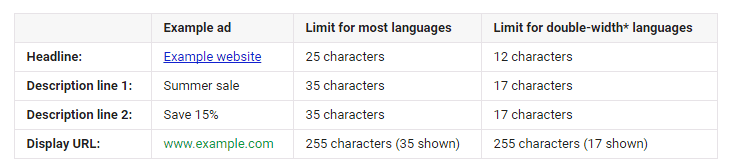
If your PPC marketing campaign is relatively new, you might not have enough data yet to make ad copy decisions. An important best practice for any online advertising strategy, not just PPC marketing, is to use data to make educated decisions. Data should always be the driving force between any major changes. Without it, your campaign isn’t supported by anything tangible.

Once ads have been allowed to run for at least one month, you can begin to analyze their data. PPC management and optimization is all about starting with a broad data set, constantly improving and narrowing the field. When you begin to dial-in on your ideal customer and brand message for your campaign, you increase your odds of success exponentially. Baseline data allows you to see what message customers respond to best, getting rid of ads that fall short before they waste your spend.
The average CTR (click-through rate) for a search ad is 1-2%. Anything over 2% is considered above average.
Look for ads that come as close to a 2% click-through rate as possible. These ads have proven they perform better than others in their ad group, making them the best choice for split testing.
The easiest way to begin split testing is to make subtle changes to your best performing ads. Start by changing the copy or headline of your ad, testing which one is more appealing to your customers. These subtle changes might not seem like they’ll have much of an impact, but you’d be surprised.
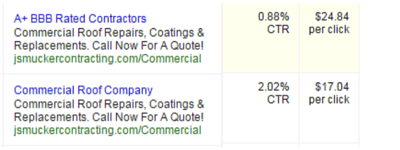
You can see from the ads above that changing only the headline message made quite a difference. Adjusting the headline not only improved CTR, it also lowered CPC (cost-per-click). Split testing allows you to find which brand message your customers respond to better. It also allows you to optimize your message by paying less for a click than you would have before.
When more people are clicking your ads and you’re paying less for it, your ROI improves.
Landing page experience
Landing pages work hand-in-hand with your PPC advertising. When you build an ad for your campaign, you also have to decide what page users will be directed to from a click on that ad. These landing pages are displayed as the “destination URL” at the bottom of each search ad. A positive landing page experience is just as important as good ad copy. Landing pages that are well-built and optimized give customers a seamless experience, encouraging conversions.
Think of landing pages as the final push customers need towards completing a conversion. Good PPC ad copy can help get customers to your landing page. If that landing page is confusing, poorly organized, slow to load, or irrelevant, your customer’s journey ends there. Split testing landing page design and messaging is a necessary step towards understanding your customers’ buying journey and how you can work to optimize it.

In the above example from HubSpot, when landing pages are optimized to continue the ad experience, carrying along their messaging and relevance, leads can increase by over 100%. Split testing landing pages is a bit more involved than testing ad copy, as new pages and designs need to be created on your site. Creating new landing pages for your split tested PPC ads helps you fully understand the customer journey and how they lead to a conversion, from start to finish.
Working together
Optimizing your Pay-Per-Click marketing strategy is not a one-size-fits-all approach, nor is it a set-it-and-forget-it strategy. Each advertiser is different, with different goals they’re trying to achieve through a PPC marketing campaign. One thing almost every advertiser is concerned about is increasing their conversions, which ultimately helps to increase their ROI for PPC marketing.
When you split test ad copy, you’re bringing your PPC marketing campaign closer and closer in line with your brand’s message. If you ads rarely come close to a 1-2% CTR, your brand message is not meeting the expectation of your customers. Split testing ad copy allows you to pin-point what works and what doesn’t, getting closer to the perfect ad for your target customer.
Adding landing page split testing into the mix allows you to continue the customer journey, controlling exactly how your customers are presented with an offer. Split testing ad copy is a good start, but focusing on other parts of your customer journey, for example landing page optimization, is important too. Rather than dropping off half way through the journey, you’re seeing it through to the end. Presenting users with the right message every step of their journey guides them through your sales funnel, into a lead, then into a valuable customer. When good ad copy works together with an excellent landing page experience, conversions improve for your PPC marketing campaign, and so does your bottom line.
Learn more about split testing, optimizing your landing pages, or Pay-Per-Click in general from our team of Google AdWords certified professionals. We offer a wide variety of internet marketing services for Lancaster, Harrisburg, and York small businesses.

Reach More Customers Through Remarketing With PPC
PPC (Pay-Per-Click) advertising is one of the best ways to reach people performing searches on Google all over the country, and even all over the world. With Google AdWords, PPC ads appear as sponsored links on the results pages of Google above and to the right of organic search results. Your exposure is instant – and your ability to reach millions of people with your company is truly powerful.
Unlike a standard Pay-Per-Click campaign, remarketing using Google AdWords goes beyond appearing on search results pages. When you choose to advertise your company with remarketing, you’re able to reach potential customers who have already visited your site. Let’s take a look at how you really can reach more customers through remarketing:
What is Remarketing?
Remarketing is a method of advertising used to reach people who have already interacted with your business online – in one way or another. These actions could be a website visit, a product view, a form submission, or a click to your site from a search PPC ad. Remarketing allows you to reintroduce your product or service to someone who has already visited your site.
Advertising with PPC remarketing is an untapped marketing channel for so many businesses. Reaching the people that are already interested in your company is a priceless marketing investment. With Remarketing, you have the power to reignite interest in your product or service, driving traffic back to your website. This is how you can lead visitors back to your site, in hopes of nudging them towards a purchase.
How does Remarketing work?
Remarketing starts by gathering information about the people who have visited your site. The purpose of tracking users is to see how they behave on your website – like what pages they visit, where they exit, and how they all lead to a conversion. All of this tracking is made possible by scripts that are added to your site, running in the background of users’ sessions.
These same basic tracking principles that supply data for programs like Google Analytics are applied to remarketing. When a user visits your site, a cookie is dropped into their browser by the tracking script. Remarketing uses these cookies to add users to pre-defined lists based on criteria you set for your campaigns. If a user matches your criteria, like visiting your site without buying a product or filling out a contact form, they’re added to your list.
Users can stay in remarketing lists for up to 180 days. During this time, they’re eligible to see your display ads while browsing other sites within the Google Display Network. The whole purpose of remarketing is to gently nudge users closer to a sale or contact inquiry on your site. They’ve already visited your site, so you know they have interest in your company. More exposure with subtle reminders of your products or services is an effective way to lead users to a conversion.
Remarketing and the Google Display Network
To really understand the power of remarketing, you need to first understand Google’s Display Network. The Display Network is a collection of websites where ads are eligible to appear in sidebars, footers, headers, or even inside content like blog posts. Site owners opt into this network, making a profit by allowing Google to use their sites for display advertising. A typical display ad for EZMarketing looks something like this:

Ads like this are eligible to appear in a massive network of sites. The network is so massive that it’s made up of over 2 million sites. That means there are over 2 million advertising opportunities at your disposal with remarketing. From eCommerce stores selling knit hats to racecar blogs, the sheer diversity of sites is unmatched by other advertising platforms.
When you choose to advertise with remarketing on the Google Display Network, you have the ability to reach your ideal customer across millions of websites. You know you’re targeting the right people, because they’ve already visited your site. Other marketing channels and advertising tactics like link building or print media ads rarely have the ability to reach your target customer in such a scalable way.
Remarketing and scalability
In a world of smarter search engines and constantly updating algorithms, the gap between organic and paid search marketing grows smaller every day. Just 10 years ago, a business used to be able to run successful organic marketing campaigns like link building or content marketing with little effort. Those were the days of easy links and engagement, where automation got you results.
Today, organic marketing takes hard work from seasoned professionals. Getting links and mentions takes a vast network of connections and even greater patience. 10 years ago, paid advertising like PPC wasn’t necessary. In 2016, a well-rounded marketing plan isn’t complete without at least one Google AdWords campaign.
With Remarketing, all you need is a solid understanding of Google AdWords and time to put towards continuously optimizing your campaigns. Just like PPC advertising on the search network, running a successful remarketing campaign does take some time to manage and monitor. You don’t need endless resources to run an effective remarketing campaign, though. You can see real result and know exactly how much you’re spending every step of the way. Total flexibility and customization is what makes Remarketing such an excellent advertising channel for almost all businesses.
Remarketing and results
When flexibility and scalability combine, you’re left with an extremely cost-effective online advertising model. If you’re familiar with Google AdWords and PPC marketing, you know you set a budget for the month. This budget is then split into daily spends. Google will never exceed your monthly spend, ensuring your ad dollars are not spent carelessly.

It’s up to you to optimize your remarketing campaign with things like placement exclusions to avoid displaying on irrelevant websites. You’re in total control when it comes to your ad copy and design, where your ads display, and at what times. But, you never have to worry about overspending. Google AdWords takes care of the math for you. What you’re left with is a dashboard full of real metrics and results.
From here, you can easily see how many clicks your ads received, how many conversions happened after user clicked on your ad, and exactly what you spent to get every sale or lead. This is where you determine just how successful Remarketing is.
If a sale from remarketing cost you $10, and that sale is worth $100 to your business, your return on investment is 10 times what you spent.
This is where remarketing comes down to how much you spend, versus how much you make in returns. You rarely get this much solid, tangible data with conventional marketing tactics. From here, you can fine-tune your Remarketing campaign to better fit your business goals. Being in front of your customers when they’re ready to buy is invaluable to your business – making remarketing the right choice.
To learn more about remarketing, call the experts at EZMarketing and talk about your PPC campaign. We’re a digital marketing agency with offices in Lancaster, PA.

How to Boost Holiday Sales with PPC
Holiday sales are the ultimate chance for companies to boost their profits and make it (back) into the black with PPC marketing. Shoppers are flocking to the web to make their purchases—and to research potential buys—days (and sometimes even weeks) before the big fourth quarter holidays roll around, which means you should be planning your campaigns and ad work early.

The key to boosting holiday sales and bids on products is to make more than you’re spending, so if you want to keep your budget the same here are 7 PPC marketing strategies you can follow to grow your profits.

Calculating The ROI of PPC
In a world of instant results, people have come to expect instant gratification from their marketing investments. When a user performs a Google search query, their results are returned in under a second. Your marketing efforts often aren’t so instantaneous. You can spend months and months trying to improve your organic search presence in an effort to land among the page one links. Organic search engine marketing is hard – it takes time and dedication to get right.
On the other hand, you can implement a paid marketing strategy like a PPC marketing campaign for more tangible, and faster, results. This is not to say that organic internet marketing tactics don’t work and shouldn’t be used as part of a comprehensive strategy. Adding PPC marketing into your digital marketing plan is one of the best ways to get ahead now while you also spend time working on your organic presence.
There’s no denying that PPC advertising is an instant way to get your website in front of people. By using the right keywords and crafting the right ads, and sometimes even targeting return users, you can create a really successful PPC marketing campaign. If done correctly, you can see massive gains from those PPC campaigns.
Let’s take a look at the ROI of PPC marketing and how to win with your paid campaigns.
Test and test again
The beauty of PPC advertising is the depth of customization. You have control over your ads, spend, audience, and more down to the smallest detail. Getting your business in front of exactly the right customer isn’t always easy with more traditional, organic marketing tactics. With PPC marketing, you know your ads are serving to the right people.
Simply put, you’ll never know the value of PPC advertising until you try it. Adding PPC marketing to your marketing strategy may not be the right move for everyone. But if done with care and good PPC management it can work for B2B, B2C, and ecommerce companies alike. If you’re not sure of the value PPC marketing could bring to your digital marketing strategy, we encourage you to try a test campaign.
Testing is a cornerstone of any good Google AdWords campaign practice. You should test, optimize, and re-test often – not just when you’re new to the PPC marketing game. Testing allows you to gather the data you want from the audiences that are important to you. Without this data, we can’t begin to make educated decisions about the ROI of any PPC marketing campaign.
Gather your data
New campaigns and ads should be left to run for at least two weeks to gather a good baseline of data. This is when you can start to sort through valuable metrics like clicks, impressions, click-through-rate, average cost-per-click, and conversions to name a few. Understanding an applying these metrics will allow you to calculate real, actual ROI from your PPC marketing campaigns – something that’s not as easy to do with organic marketing campaigns.
A good, high-level view of important data appears at the campaign level. In Google AdWords campaigns, this view displays your different ad groups and corresponding important metrics:

In this example, you can see data for a fairly new search network campaign. We want to focus in on number of impressions, CTR (click-through-rate,) average CPC (cost-per-click,) average position, conversions, cost per conversions, conversion rate, etc.
We’ll use this data through-out the rest of this blog post to calculate ROI data.
Calculate return on ad spend
After you have a good set of data from your campaigns and ads – about a month’s worth – you can do some simple math to get an idea of your ROI. In the case of PPC marketing, ROI is referred to as ROAS, or Return On Ad Spend. ROAS is a high-level calculation that lets you see the effectiveness of campaigns with just a few metrics. Here’s how to calculate ROAS:
(Profit – Cost)/Cost = ROAS
Using the data above, let’s see what ROAS would be if the business profited $1,500 from this PPC marketing, spending $512 on the campaign:
($1,500-$512)/$512 = 1.92 or 192%
This means that this business’s Return On Ad Spend is 192%. At a high-level, they’re not only breaking even from a PPCmarketing campaign, but profiting.
If your cost begins to outweigh your profit, you should revisit those PPC marketing campaigns. This is where you need to edit and optimize your campaigns to bring ROAS positive.
Calculate profit per impressions and clicks
You’ll also want to understand how valuable impressions and clicks are to your bottom-line. Profit per impressions and clicks goes beyond the usual click-through rate and conversion data and gives you another valuable metric to gauge the value of your ads. Too many people spend time racking up impressions and clicks on poor-value ads without understanding how these numbers actually effect their spend.
We’ll use this data again for two equations – profit/impressions and profit/clicks:
For these two equations, we arrive at the profit metric a little differently. In this case, profit is equal to the cost of the campaign minus your sales value. To get the most out of this equation, you’ll need to know the value of a sale to your bottom-line. For the sake of numbers, we’ll use a cost of $512 again and a total sales value of $312:
$512 – $312 = $200 profit
The math becomes simple for the rest of the calculations. You simple divide your profit of $200 by your total number of impressions, then by your total number of clicks:
$200/7,855 = $0.03 profit per impression
$200/288 = $0.70 profit per click
In the case of this example, we can see that impressions aren’t costing this business much in total. On the other hand, we can see this business is paying more on average for a click than they are making. Even though we saw a positive Return on Ad Spend in the previous calculation, there is room for improvement. It would be a good idea to find ways to drive the Cost Per Click closer to the profit per click to ensure more is being made than spent.
Make educated decisions
Return on PPC advertising spend, profit per impression, and profit per click are just a few, high-level numbers you can quickly calculate to your ROI on your Google AdWords campaigns. There are many, more complicated numbers you can dive into to really see how PPC marketing affects your bottom line.
In all of your calculations, don’t forget about the obvious data you have. Sometimes, no math is needed to see if something is or is not working. In the example about, the cost per conversion is around $260. We used a total sales value of $312 to calculate profit per impression and click. We can clearly see that a conversion costs less than the value of a sale for this business, adding more positive ROI to this PPC marketing campaign.
These metrics are quick and easy to use. They allow you to make educated decisions when editing and optimizing your PPC marketing campaigns. Instead of following the best practices you think you know data can give you hard evidence of what’s working, and what’s not. Remember, if PPC advertising is making you money, you’re already seeing a good ROI. If it’s not talk with our PPC agency in Lancaster, PA for help.