There is no doubt that Google owns the majority share in the search engine industry. Bing and Yahoo are steadily taking more of that share, and an Apple search engine could do serious damage by having all of their devices default to their own engine. Whatever the case may be in the future, the ranking in Google is currently the most critical for businesses, as the search engine giant owns 70% of the search engine share.
With 3.5 billion search queries per day, your business could garner a lot of website traffic by ranking for keywords related to your business. Given the rise of YouTube, Facebook, Amazon, and more as search engines, just how important is it to rank in Google regarding your SEO?
Ranking on the first page of Google: statistics
Multiple studies have turned out a variety of statistics over the past few years regarding the impact of Google ranking, dealing with factors including:
- Branded vs. non-branded searches
- Searches without ads or with ads (ads above and/or beside)
- Mobile vs. desktop
- Long-tail keyword searches
When a user performs a search, about 90% of clicks go towards the organic search results, with the remaining 10% to the pay-per-click ads above or beside the organic results. While PPC campaigns are still important in an integrated marketing strategy, ranking organically lets you own those positions and gain more traffic.
This heat map from Mediative shows how most users look past the advertisements to get to organic search results.

Similarly, the percentage of traffic from the first page of Google is about 91%, while only 4% of users click through to the second page or results, 1% to the third page, and then it drops off into fractions of a percent.

This tells us that if you aren’t ranking on the first two pages on Google, the likelihood of you gaining any organic traffic to your website is less than 1%.
Even if you are ranking on the first page of Google, it is obvious that the top results get a higher click-through rate (CTR) than the others. Click-through rate is the number of users that click through to a certain result compared to the rest of the results on the page.
So when it comes to click-through rate on the first page of organic search results, the biggest benefit for ranking in Google is that the first position typically gets about one-third of all clicks, but with many different factors, the results may vary.
This can be backed up by click-through rates of first page organic results in Google.
Click-through rates of first page results
With an ongoing study on CTR by Advanced Web Ranking, which is one of the best keyword tools available, we are able to see results from testing these factors from hundreds of thousands of keyword searches and websites.
So let’s break down the click-through rates for all the different variations of searches with data from the United States.
Overall CTR for all mobile vs. desktop searches
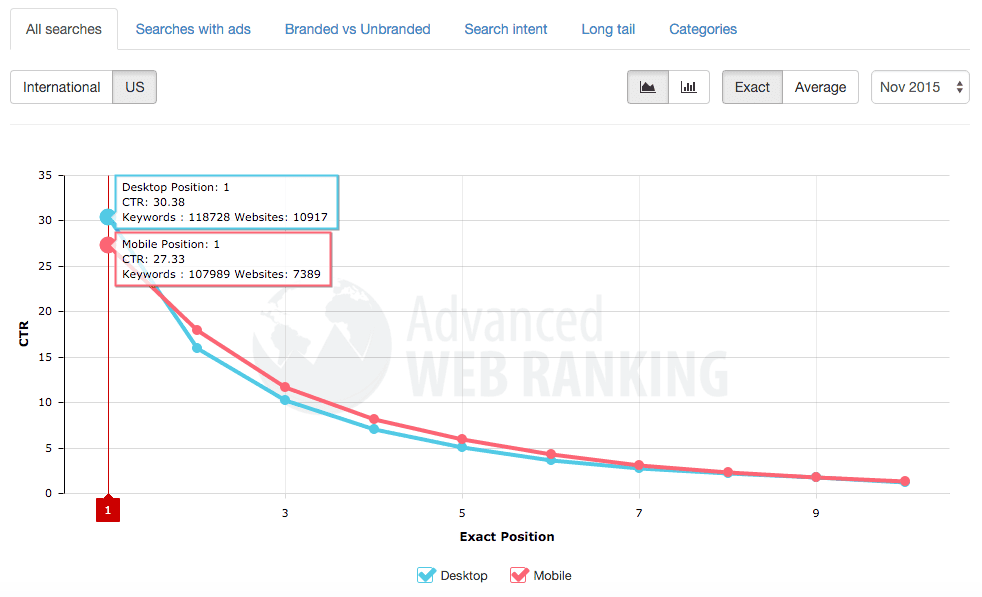
Mobile has overtaken desktop as the most-used device for searches on Google, so it is important to have a mobile-friendly website to even be considered for a first-page ranking. In this study, 30% of desktop searches click on the first position, while 27% click on the first position on mobile devices. This could be because on a desktop computer, you can see 6 or 7 results on the page and choose to go with the first, whereas with less landscape on mobile, you only see two or three results and give preference to what seems like the best.
CTR for searches with or without ads
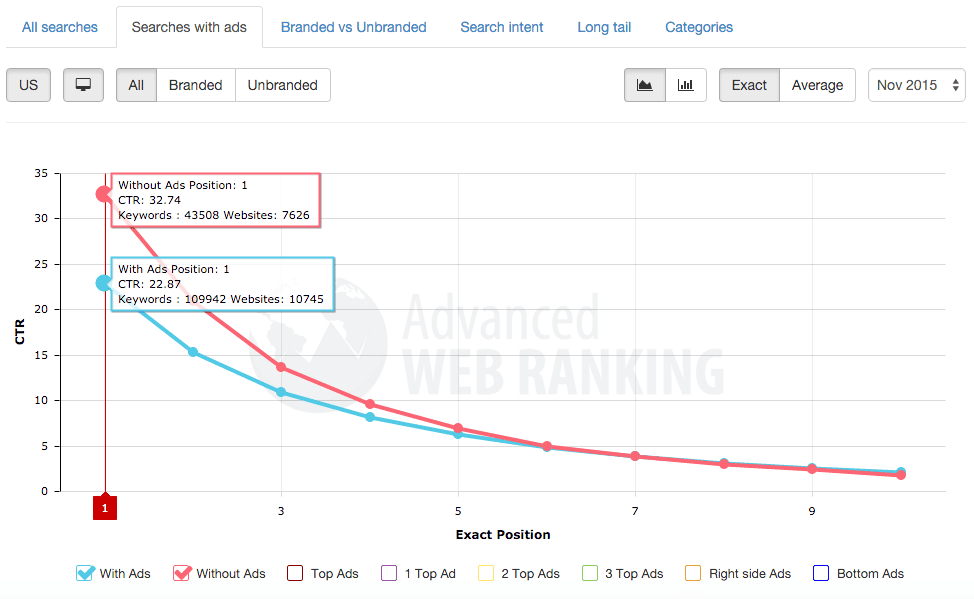
When ads are displayed, whether above the organic results or beside them, organic click-through rates take a ten percent hit because users have other options to choose from. This is especially true on mobile where ads are displayed, because they take up the screen before the searcher has to scroll down to organic results.
CTR for branded searches with or without ads

When someone does a brand search, they are specifically looking for a company that they know, trust, have heard of, or have used before. So there is a much higher likelihood that said brand will show up higher in results, which is why it has the highest CTR of 42 percent among these tests. When ads come into play, it allows for competitors, or even the searched brand itself, to pay for ads that display above organic results and potentially steal traffic from their competition.
CTR for unbranded searches with or without ads

An unbranded search is when a user is looking for a product or service, but they do not know which company they want to use, or they are shopping around for the best prices or features. So it makes sense that there is a bit of a drop with unbranded searches when it comes to unbranded searches, especially when ads are involved. At a 22 percent CTR for the first position of unbranded searches with ads, it is the lowest click-through rate for all of the studies done. If you are doing also doing pay-per-click using Google AdWords, unbranded relevant searches would be the keywords to target, as they are stealing a lot of the traffic from the top organic results.
CTR for branded vs. unbranded desktop searches

A big reason you want to build your brand awareness, loyalty, and trust is so that people begin to search your brand name along with your services or keywords. As you can see, when a branded search is done on desktops, it gets 41 percent of the clicks as opposed to just 26 percent for unbranded searches. However, when it comes to the second position and further down, both searches tend to match when it comes to click-through rate.
CTR for branded vs. unbranded mobile searches

On mobile devices, there isn’t as big of a difference between branded and unbranded searches as there is on desktops – but there is still a difference. Oddly enough, unbranded searches have a higher CTR in positions two through five, and then begin to match up with branded searches.
CTR for long-tail keyword searches on desktop
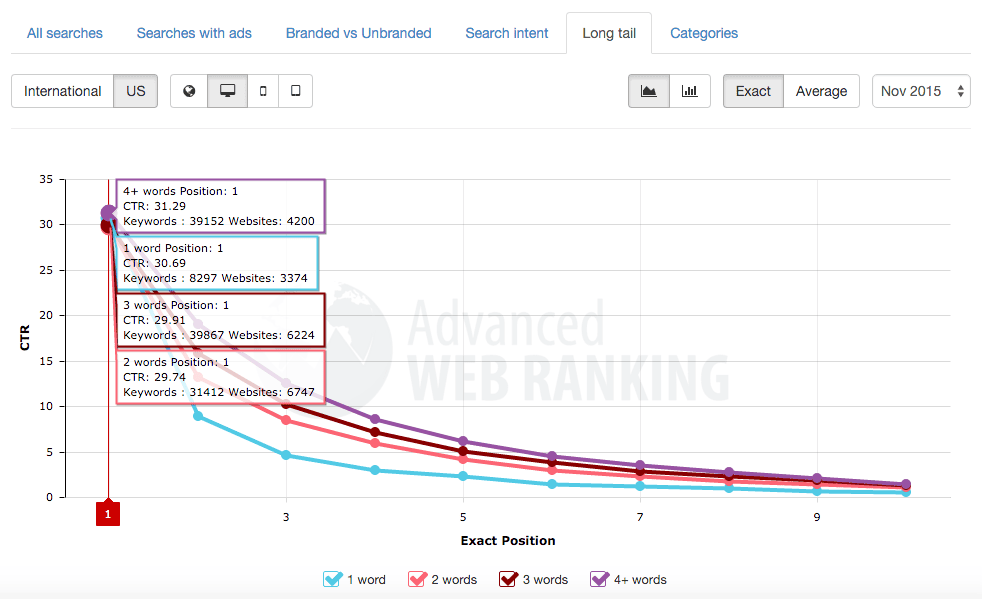
Long-tail phrases, which include at least two keywords, pose much more precise intent. Long-tail keywords are less competitive, which makes them easier to rank, and you should consider putting together a very in-depth long-tail keyword list to use in your website copy and content marketing strategy. When searches are done with four or more keywords, they have a slightly higher CTR on desktop than searches done with fewer keywords. But all of them have around a 30 percent CTR on desktops, which is why you should begin to target and track your long-tail keywords.
CTR for long-tail keyword searches on mobile
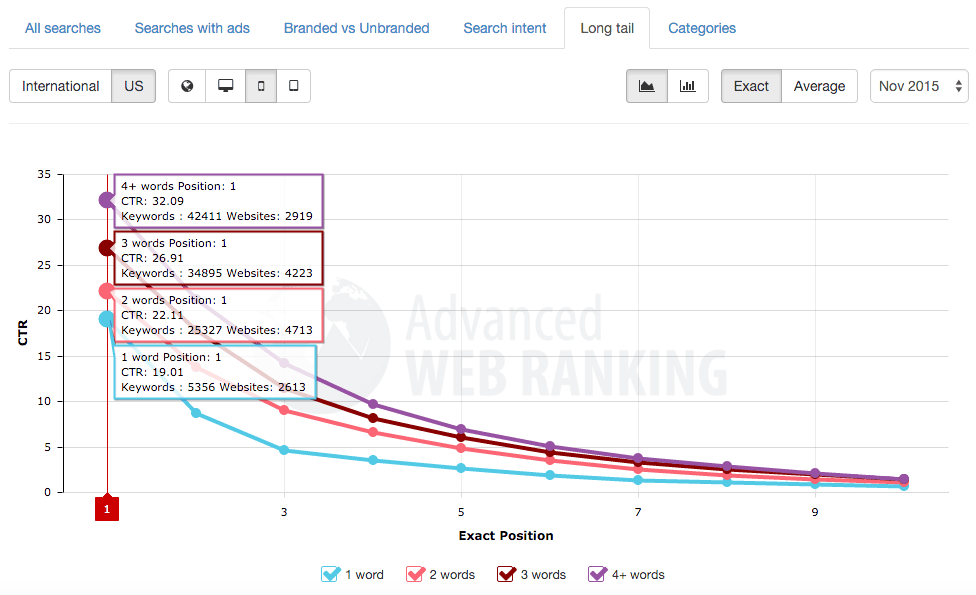
When it comes to mobile, long-tail keyword searches tell a slightly different story. While four or more words still get the highest CTR at 32 percent, there is a drastic drop from three keywords to two, and especially to one keyword. One-keyword searches on desktops got a 30 percent CTR, but on mobile they get just a 19 percent CTR.
Calculating your potential traffic
As you can see, there is a huge benefit to ranking on the first page of Google. Your brand awareness will rise, hopefully along with more branded searches, and so will organic traffic to your website.
Let’s say that you ranked for a long-tail keyword that got an estimated 1,000 searches a month. Typically, you would garner about 30 percent of those click-throughs to your website.
1,000 searches a month X .3 CTR = about 300+ more visitors to your website
Now imagine if you started to rank for a combination of different long-tail keywords, or specific buyer keywords for your products and services. You can begin to see how it will add up to a ton of monthly organic traffic to your website, resulting in more leads, sales, and hopefully long-term and loyal customers to your company.
How to get keywords ranking in Google
Without going into too much detail about the entire process that an SEO agency would be able to do, here are some top-level tasks you can do yourself that can help to get your site ranking.
Optimize your website
First and foremost, you want to optimize your website for search engines. This means having a mobile-friendly site with a fast load time and a good user experience. Every page should be optimized with tags and copy, and any issues affecting your website rankings should be addressed.
There are over 200 ranking factors that experts have determined that Google uses. It becomes even more complex, as Google’s Matt Cutts has also stated that some of those ranking factors can have up to 50 different variations.
Therefore, one of the best digital strategies is a content- and data-driven strategy that acquires authoritative links and engages with a social audience.
Your website also needs better copy and a strong customer journey, because without these, users may bounce off of your site and back to the search results where your competition is. If you have a high bounce rate, which is when someone goes to a page and leaves it in under a minute without visiting another page, you should see if your website is making any common website mistakes that are raising your bounce rate.
Keep in mind that the more high-quality content pages you have on your website, the more chances you have to rank. If you have a smaller website with only 10-20 pages, then it will be much harder to steal traffic from your competitors with a larger website presence.
Start producing resourceful content
One easy way to add more relevant pages to your website is to help your visitors find a solution with a resourceful blog. We’ve gone into the benefits of blogging for business before, but essentially, it helps to build your brand and authority, earns trust in your industry, allows you to engage socially by sharing your content across social media networks, and boosts your long-tail rankings which will drive more traffic – all of which will hopefully travel through your funnel to generate conversions.
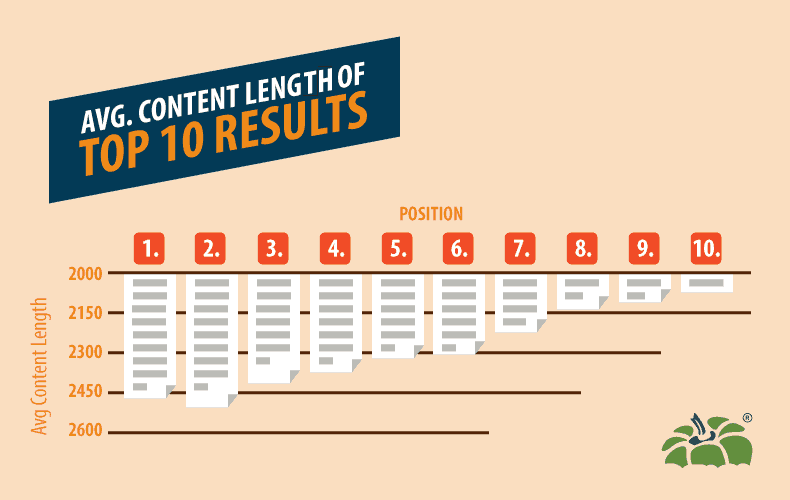
The best type of blogging is long-form content, which is content that is generally 1,000-3,000 words. The average content length ranking on the first page of organic results is typically at least 2,000-2,500 words, as you can see in this chart.
When you create this long-form content, whether it’s an ultimate guide to a service in your industry or a how-to instructional post that walks someone through a problem, you may begin to attract links in your industry through outreach as well as content and social media promotion. With these authoritative and industry relevant links, you will begin to see those content pieces ranking higher, which will result in more organic traffic.
You can use this strategy by looking to see what content your competition has been developing, and create something far better and more valuable. Then you can research who linked to and mentioned them for their content and reach out to them to also get a link. When you can get the same websites that mention your competitors and some more, you should begin to outrank your competitors online.
Other forms of content other than blogging could be creating eBooks, whitepapers, case studies, influencer interviews, videos, infographics, slideshows, and much more.
When it all comes down to it, the main factors in ranking are optimizing your website and earning links, mentions, and shares from your industry. There are are many specific strategies you can use to try and rank online, but sometimes it’s best to worry about your business and leave the rest to the experts when you want your keywords ranking in Google.