SEO
Why Does SEO Take So Long? – Ask EZ
A question I get asked all the time is, “Why does SEO take so long?” Now imagine you’ve just hired a new SEO company. You’re excited. They’ve walked you through their strategy for how they’re going to get you found on Google and drive all this traffic to your website.
But you’re about two months in and nothing seems to be happening so what’s wrong? Well probably nothing, the truth is SEO takes time. Google actually says it takes 4 to 12 months to really start seeing results.
But why does it take so long? And what does that mean for you? If you want to learn more keep watching.
Hi, I’m Tom Malesic, Founder and President of EZMarketing, and you’re watching Ask EZ. This is where small business owners go to get real answers to their marketing questions.
SEO Has Changed
One of the reasons we hear this question is people have an outdated perception of how SEO really works.
In the early days, it used to be a pretty simple formula right? You pick some high volume or really popular keywords, you put them on your website just a ton of times over and over again, and then you get lots of links back to your website, and bingo: now you have results.
If it were a math equation it would look like:
A+B+C=Success!
But now the equation looks a little more like this:
Today SEO is MORE complicated with MORE variables which means it just takes a lot more work to get through.
How Long DOes SEO Take?
It Depends on Your Content
Great content takes time. Effective SEO relies on high-quality content that’s relevant for your customers. This is things like copy on your website, maybe blog posts, guides, infographics, or even videos like this one.
Look SEO takes time because great content doesn’t happen overnight. It takes time. It takes time to write it, to design it, to optimize it, to promote it. And certainly to get backlinks to it. The point is if you want results from your SEO you have to invest the time to create the best possible content.
It Depends on the Competition
Asking how long SEO will take really depends on a lot of things. One of the biggest factors is your competition.
So asking how long it will take to rank on Google is kind of like asking how fast do I need to run to win the race? Well it depends on how fast your competition’s running, right? If you’re running against a bunch of slowpokes you probably don’t have to work real hard to win. But if you’re running against very trained marathon runners you might be in trouble. So chances are, your competitors are doing SEO and winning is a moving target.
Also, some keywords in industries are naturally more competitive than others. So if you wanted to rank for “industrial powder coating service” that’s going to be relatively easy to rank for compared to if you wanted to rank for “auto insurance” which is insanely competitive.
It Depends on Your Budget
If you’re outsourcing your SEO service, how long it takes also depends on your budget. Look there’s a lot that goes into SEO: we have things like site audits, writing content, optimizing your website, building backlinks.
Look it all takes time and if you’re only spending a couple hundred dollars a month, you’re not giving your SEO company very long to work, and it’s going to take them longer to get results.
Now that doesn’t mean that you should have to wait 4 to 12 months to understand what your SEO Company is doing for you. They should be able to explain what they’re doing and why and be able to show some level of progress.
Get Long-Lasting SEO Results
SEO does take longer than other types of marketing, but the good news is it also lasts longer. Unlike Google Ads that disappear the second that you stop paying for them, SEO builds over time. You still need constant maintenance, but once you rank, you’re going to keep getting results and traffic will last longer.
If you want to get better results from Google I invite you to fill out the form below so that we can give you a FREE SEO Audit.
We’re going to give you a report and lots of suggestions on what improvements you need to make to your website to get better visibility on Google. And of course, if you like this video don’t forget to like and subscribe.
What Are the Top Google Ranking Factors? – Ask EZ
What are the top Google ranking factors that affect the search results? Getting your website to rank on Google can be a real challenge. Google has over 200 ranking factors, so which ones should you really worry about?
To find out which Google ranking factors make the biggest impact on your website keep watching.
Is LinkedIn really useful for business? – Ask EZ
This Week’s Question: Is LinkedIn really useful for your business?
What can I do to get found online? – Ask EZ
This Week’s Question: My customers can’t find my business when they search on Google. What can I do about that?
How do I get my business name out there? – Ask EZ
This Week’s Question: How do I get my business name out there?
Transcription:
Have you ever found yourself saying, “how do I get my name out there? People just don’t know who I am.” Many small business owners they feel like they are the best-kept secret.
In the marketing world, the problem that you’re solving is brand awareness. It’s how do you get people to recognize and remember your business. We know that people are more likely to buy from a business that they’re familiar with. If you’re tired of being the best-kept secret, keep watching!
Hi, I’m Tom Malesic, founder and President, of EZMarketing, a marketing company in nearby Lancaster, PA, and you’re watching Ask EZ. This is where small business owners go to get real answers to their marketing questions.
how do you build brand awareness?
So how do you build brand awareness? It really comes down to three things: being recognizable, being relatable, and being active.
Be Recognizable
Let’s start with being recognizable. When you see this shape, what company do you think of?
Combined with their famous red and white logo, Coke is the world’s most leading recognizable iconic brand. Over 94% of the world will recognize that Coke bottle.
So how do you be recognizable? It starts with your logo, it’s the colors you use, it’s the fonts that you select. It’s really about being consistent from one advertising source to another. So that if somebody looks at your website design, and then they look at your business card, and then they look at your social media marketing, and they look at a print ad, does it all look like it’s the same company? It sounds so simple but most small businesses, they just don’t do it.
Be Relatable
Getting people to know about your business isn’t just about your logo and the visual identity, it’s also about your message, your values, and what you say you do. It’s being relatable, especially for small businesses, people buy from people, not from nameless, faceless companies.
Does your prospective customer feel like you can really solve their problem? When someone reads your website do they come away with, yes, finally somebody gets me!
Does it create an emotional connection with that prospective customer? An
example of this would be our customer, Blessings of Hope. They’re a food bank, for food banks. Their old website just kind of talked about what they did and really didn’t pull in that emotional connection. When we changed it we really focused on their message, which is, “peace begins, when the hungry are fed.” It’s not what they do, it’s why they do it.
Be Active
But being recognizable and relatable it’s still not enough if you’re not spreading the word about your business. So our last tip is, be active. You have to do something. You can’t just sit at your desk, in your four walls, and wave your magic wand and think people are going to know who you are and want to buy from you. It takes five times for someone to hear about your business so that they actually remember you.
And this speaks to doing a lot more marketing. So it’s doing a great website design, it’s social media marketing, it might be print ads, it could be a variety of things, it could be wrapping your car with your logo all over it, you could sponsor an event, you could even leverage some of your existing customers by having a referral contest or asking for reviews.
The point is you need to do a lot more marketing so that people will remember who you are.
Your Homework
So here’s your homework:
I want you to take all of your marketing materials, whether that’s your business card, a printout of your home page, it could be some printouts of your social media ads, any direct mail, and I want you to lay it all out on a table.
Then I want you to look at it and say does it look like it came from the same company? Is it recognizable? Then I want you to read the copy, is it relatable? Are you getting your message out there correctly? And then last, I want you to look at it all, and say what aren’t I doing right now and pick one more marketing tactic, and do more marketing to take action.
If you’re talking with marketing agencies in Lancaster, make sure you give us a call. Our marketing company specializes in small businesses in Central PA. We’re happy to help, and don’t forget to like and subscribe!
How do I get more online reviews? – Ask EZ
This Week’s Question: How do I get more online reviews?
7 Things You Can Do Now to Improve Your SEO Rankings
As technology continues to change, so do the elements it takes to run your business effectively. Search Engine Optimization (SEO) is an essential part of that evolution, and is necessary in order for your website and your business to rank in searches.
To see the most return on your investment, business owners should be researching and implementing SEO marketing, or hiring a professional SEO company to help. Even once you’ve got the basics in place, there’s a lot more you can do to rise in the search ranks. Here’s a list of steps you can take to improve your SEO marketing and get your business the results you want.
Add Contextual Keywords
Keywords aren’t going anywhere, despite what you might read elsewhere on the internet. But how you use keywords in your content is changing.
Early SEO marketing involved stuffing the same keywords into your content over and over again. Now, having contextual keywords on your webpages is an essential part of SEO marketing.
Contextual keywords – sometimes called semantic keywords or latent semantic indexing (LSI) keywords – are words and phrases that are related to your overall topic. Search engines are now smart enough to know that people use different words to search for the same topic. So Google doesn’t just look at exact-match keywords; it looks at related words to get a deeper understanding of what your content is about, so it can deliver more accurate search results.
For example, let’s say your primary keyword is “SEO,” since that’s what we’re talking about here. You should still optimize your page content around that keyword and include it in your title tags and meta descriptions, H1 header tags, etc. But to give Google a better understanding of what you’re talking about, you would include related search terms like “web page optimization,” “how to optimize your site,” “search engine results,” “keyword research”…you get the idea.
You can find semantic keywords easily by using this handy tool, LSIGraph.
Try Pillar Pages
Pillar pages are closely aligned with the concept of contextual keywords. The idea behind a pillar page is to provide an overview of a specific topic with related subtopics and keywords presented on the same page. So the top portion of your web page design would focus on the main keyword, while the lower portions would incorporate contextual keywords with links to other related pieces of content. Here’s an example of something we did for one of our clients:
Top of Page
On the top of this page, you’ll see words like “personal injury lawyer,” “personal injury,” that establish the core topic for the page. Adding your primary keywords on a pillar page will help Google recognize content much more effectively, especially when supported by the lower half of the page.
Lower Half of Page
Throughout the rest of the web page, we added contextual keywords to complement the primary keywords of the page. Covering subtopics like “slip and fall injuries” or “wrongful death” add context to the page that helps both readers and Google’s search algorithms understand more about personal injury law.
So does adding these contextual keywords work? Absolutely. The rankings for this specific SEO-optimized page far outpaced any of the other standard pages during our tests on this site. Also keep in mind that “personal injury” is a competitive term when it comes to searches.
Don’t Be Afraid to Test
If you’re launching a new product, you don’t just throw it together and ship it out to the masses, right? You test it, most likely several times, before you even let anyone see it—the same goes for web pages.
How are you going to know what works and what doesn’t unless you really test it out? And we don’t just mean changing a few words or the color of a button. We’re talking about at the page level itself.
For example, why not make one page that focuses on long-form content while creating another page with a pillar design? Create the pages, put them on your site, and let them sit in place for a month. After some time, take a look at your analytics and see: Which page is getting the most impressions? Which page has fewer exits? Which page is viewed longer? Which page gets the most shares?
Looking at these analytics will help you determine which pages are working best for your business. You can also experiment with your approach to SEO on each page. Then, with real-world data in hand, you can refine your design and SEO marketing approach to get better results.
Don’t Be Afraid to Write
In the world of SEO marketing, the more content you have, the better. If you think you’ve written enough, write more.
Despite claims that people have short attention spans and don’t read, searchers actually like long-form content. The average word count of a first page Google result is 1,890 words, according to a study by Backlinko that analyzed over one million search results.
Longer articles rank well because they let you cover a topic in more depth, and your readers don’t have to go to multiple sources to find an answer. So go ahead and write 2,000 words, as long as you’re writing something that’s relevant and helpful to your audience.
10 Words are Worth One Picture
Have you ever heard of an alt tag? Better yet, do you include them on your website religiously?
An alt tag is an HTML tag that is used to add text descriptions to images. They’re designed to accommodate web accessibility. A major side benefit of alt tags is that give you roughly 10 words of added, valuable SEO content to your website. Google can’t read images, so it’s your job to explain what’s in each picture on your site.
When writing an alt tag, make sure to be descriptive and specific. Describe what the image is about, but also layer in your keywords. Here’s an example of a good and bad alt tag.
A Weak Alt Tag
“Picture of bikes on a wall.” — Never waste your time using the word ‘picture’ in your alt tag. Google already knows it’s an image. Describe what’s in the image instead.
A Strong Alt Tag
“Road bikes in our bike shop in Lancaster, PA.” — See how easy it is to include your keywords or semantic keywords in the alt tag? In this case, the alt tag describes the image, but also includes keywords like “road bikes” and “bike shop” and includes a geo-location reference.
It’s easy to update your image alt tags – no developer support required! If you have a WordPress site, just log in and go to the image you want to add an alt tag to. From there, just enter your alt tag in the Alternative Text block and hit save. You’re done!
Make It Local
Another easy way to improve your rankings, especially for local SEO marketing, is by geo-locating your content—including your metadata. So if your business is in Lancaster or Harrisburg or York, let people know that. Tell them in your site text. Make sure you include a footer on every page with your address and local phone number. You can even add a Google Map to make it easy for them to find you.
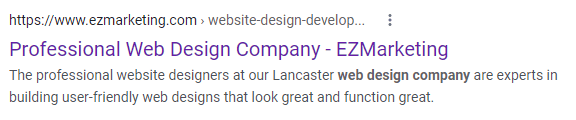
Apart from your website text, make sure you include your location in your page title and meta description as well. Start with your keyword, but make sure you insert your location. Your location is even more important than your company name. If you geo-target well, a title tag should look something like this:
Make Your First Link Count
Finally, get familiar with the “First Link Priority” Rule and follow it. The rule is: if you include two links on a page that both point to the same page, Google will only pay attention to the first link. So for example, let’s say you have a link in your main navigation that goes to your product page. If you place another link farther down the page, Google won’t recognize it. This rule was put in place to avoid making spammy links just to include different anchor text.
It’s a big reason why you should use keyword-specific links in your top-level navigation. How many times do you see a generic “products,” link rather than a specific keyword like “custom furniture” that would be more informative? Even if you included a “custom furniture” link later on the page, Google would only see the generic “products” link in the header, because it’s the first one on the page.
Well, there you have it. Seven ways to improve your search rankings, and most without the need for a designer or developer. With any SEO marketing, the key is to implement, test, and adjust. There are no guarantees, but if you’re diligent and keep working at it, you’ll see results.
As a local SEO company in Lancaster, PA, we’re very familiar with making these types of changes to website designs and many of our clients have seen rankings go up noticeably in 30 days. However, it can take much longer to see results, depending on the competition in your industry. Just stay the course, keep making improvements, and let us know if we can help you along the way!