3 Ways Heatmaps Can Improve Your Website Conversions

With the first quarter coming to a close, it’s clear that the industry experts were correct in suggesting data and analytics will drive the industry in 2017. Not only do marketers have more access to compelling data than ever before, they also have tools to analyze it, interpret it, and put it to use.
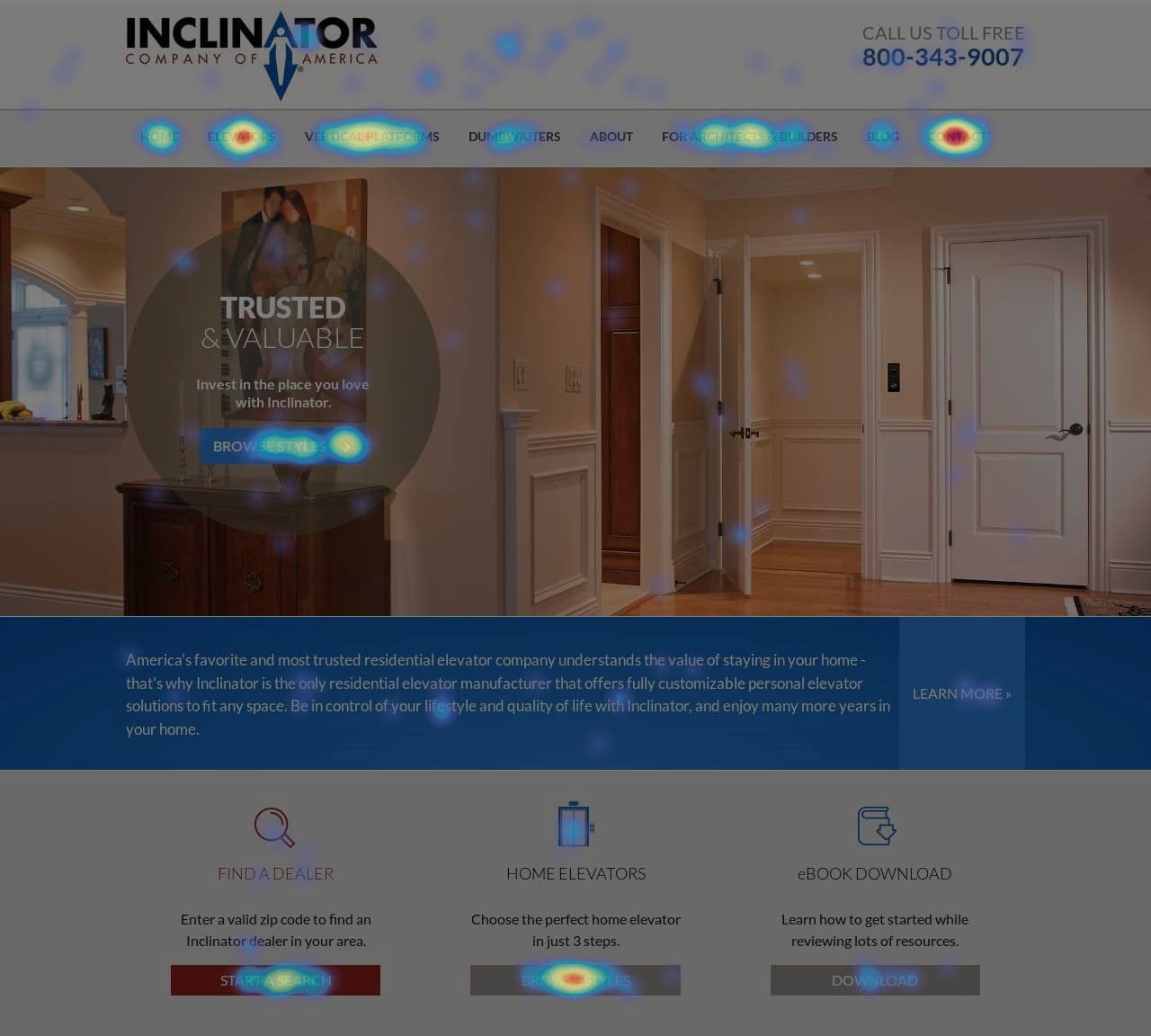
One of the most useful data gathering and aggregating tools is called a “heatmap.” A heatmap shows how visitors interact with a webpage: where they look, what they click on, and how they scroll. The red or “hot” areas of the map represent the greatest amount of activity.

Heatmaps provide real-time information to marketers seeking to respond to industry changes and trends as quickly as possible, making it easier for the customer to find what they’re looking for and eventually convert to a sale.

Here are just a few ways heatmaps can help you optimize your website design and improve conversions.

1. Identify where users become confused

One of the most common sources of confusion on a website is the navigation bar. After all, this is where a user is intuitively trained, for better or worse, to look seek out information (hence its name). If a visitor to your website is spending a lot of time hovering around the navigation bar, it’s reasonable to assume that they’re not sure where to click. They are confused.

While there are a variety of factors that result in nav-bar confusion, a few are very common. Perhaps it contains too much information to digest, it’s unnecessarily cluttered, the text is too small to read, or drop-down menus are difficult to click.

According to some case studies, removing the navigation bar all together is the key to greater success. Consider the type of information your user is looking for—is the navigation bar necessary to lead them there, or would a simple call to action suffice?

2. Test your calls to action

What if your CTAs simply aren’t generating clicks? A heatmap will show you if users are noticing your CTA buttons, if they’re hovering over or near them before making an action, and what action they’re likeliest to take afterward.

In the example below, you’ll see that the landing page was optimized with an effective call to action. The heatmap shows how the CTA button clearly receives the most attention on the page.

Heat Map Example

Source: Kissmetrics

Furthermore, a “click map,” featured in most heatmapping software, can show you whether your CTAs are actually generating clicks, and if those clicks result in additional actions. A click without a form-fill is, however, just a click!

The bottom line is that calling a visitor to action doesn’t amount to much if the visitor doesn’t click. (We discuss this in our upcoming Conversion Marketing Seminar.) Split-testing your CTAs is critical when you’re trying to determine their effectiveness. Placement, color, text, size, and many other factors can make the difference between a strong call to action and a weak one.

3. Discover which parts of your Web Design should be optimized

We’re in an age of rapid change, and yesterday’s tools are no longer adequate to engage consumers and drive conversions. In a sense this means your website design should be adapting to the viewer on a moment-to-moment basis.

Such intuitive web content is of course difficult to create and maintain on the fly. What you can do, however, is use heatmapping to determine the parts of your site that can be optimized. This is known as conversion rate optimization, or CRO.

This allows you to challenge conventional wisdom and see what works best for your visitors. Should the most important information appear above the fold? (Maybe not!) What’s causing visitors to abandon their shopping carts? How do numbers trigger the likelihood of a purchase?

When you use heatmaps to answer questions like these, you no longer need to rely on anecdotal data, or even the hard data of other businesses. Your customer is your customer, and your job is to cater to their needs, not the people visiting another website.

Want to learn more about how to design and optimize your business’s website? Check out our business web design guide!

Start A Conversation

Read more

5 Key Takeaways from the 2017 CMI B2B Report

The most recent B2B content marketing benchmarks, budgets, and trends report for 2017 is out. Here are a few interesting key takeaways to take from the report.

1. Content marketing spend vs. increasing amount of original content

img1 img2

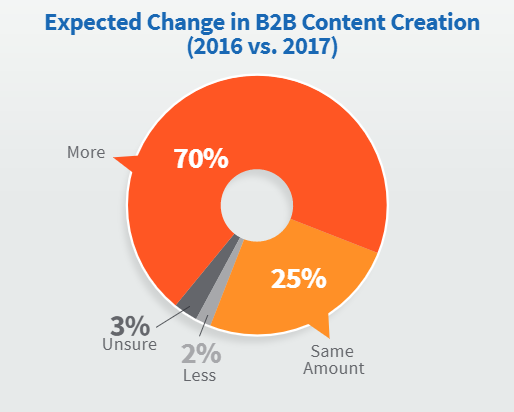
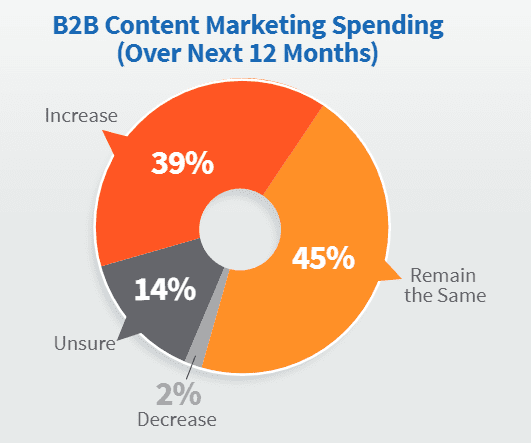
Of those polled, 70% said they expected to be generating more unique content, but only 39% of those expected to increase their marketing spending. If you’re wondering how so many marketers expect to generate more original content for the same amount of spend, consider optimizing existing content to boost site traffic.

Content audits are a great way to capitalize on work you’ve already done while keeping your content fresh and relevant to readers and search engines. Besides, there’s little point to inundating a website or campaign with more content if your old content is still performing well. In the case of original content vs. new content, less is more as long as the content is high quality. Refreshing old content is, generally speaking, more preferable than generating brand new marketing material if you are still seeing a high return on your investment on creating that content.

2. Content marketers are going after lead generation and brand awareness

It’s integral to any marketing campaign to establish clear goals early. Goals are how your company will gauge the success of its content marketing, but also how it will direct those same marketing efforts.

img3

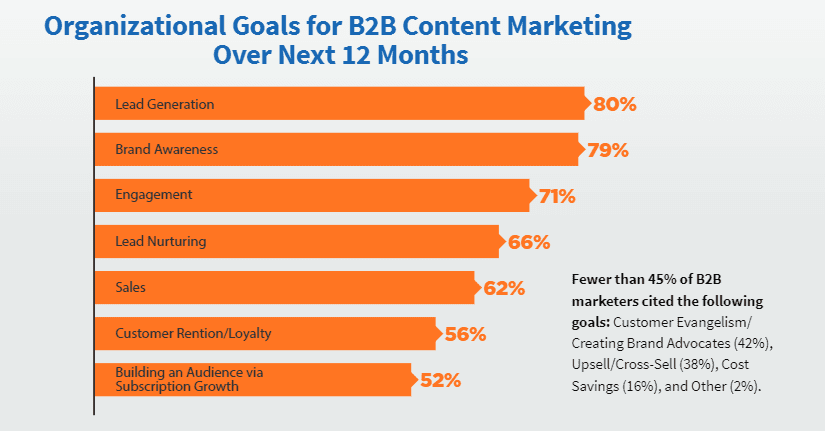
Lead generation is a logical goal for marketers, and so is increasing your brand awareness; but the interesting part is that fewer than 45% of marketers are worried about creating brand advocates. Never underestimate the power of customer evangelism because if you aren’t encouraging positive feedback or providing your audience with a space to build that fan base, then you’re missing out.

We’ve talked about relationship management before and how it can be used to frame public perception of your brand, so if you’re not actively engaging with your customers and managing the relationship your brand has with them, you’re losing an opportunity to have others help to expand your brand awareness.

With social media, viral videos, and brand enthusiasts, it’s never been easier to increase the reach of your brand. If you have customers out there spreading word of how awesome you are, doesn’t that kind of tie into generating new leads as well? The more people who know about you, the greater your opportunity for new leads.

3. Email isn’t dying as quickly (or at all) as some marketers believed

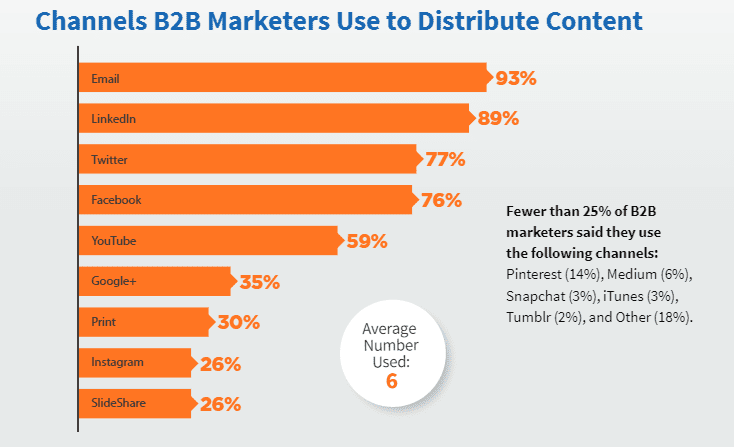
There’s been a deal of consternation among industries as to whether email is a dying marketing channel, or if it’s simply being wasted on the younger generation. Despite the many varied articles and blogs regarding the topic, the marketers polled by CMI—93% of them—were utilizing email to distribute their content.

img4

4. Social media is still top of its game as a go-to marketing tactic

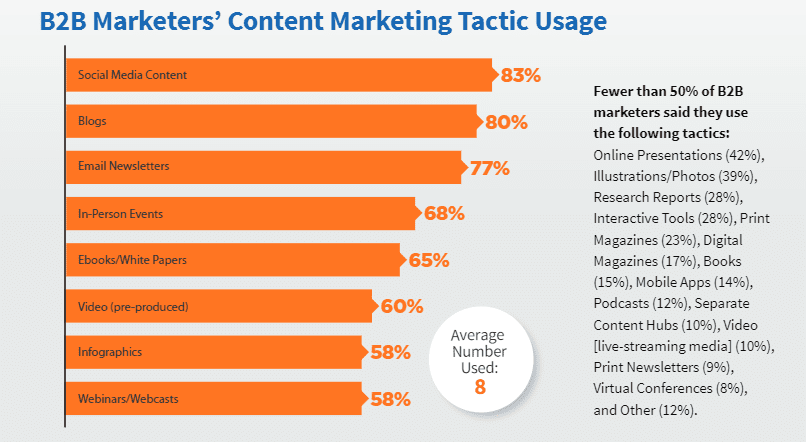
While content marketers are still using an array of tactics, social media is being used by more than 80% of them, which isn’t really a huge surprise. With the changes Facebook made to its business pages and platforms like LinkedIn for B2B businesses, social media is an ideal channel and tactic for content marketers.

img5

It’s also important to note the continued popularity of infographics and whitepapers. These tactics are fairly evergreen, as well as being a reliable way to get backlinks. Remember that whole ‘less is more’ line from earlier? Well, implementing a few updates to an existing (but potentially out of date) eBook, whitepaper or infographic can make it good as new again, or in the case of content marketing, relevant.

5. Site traffic the leading metric for content marketing measurement

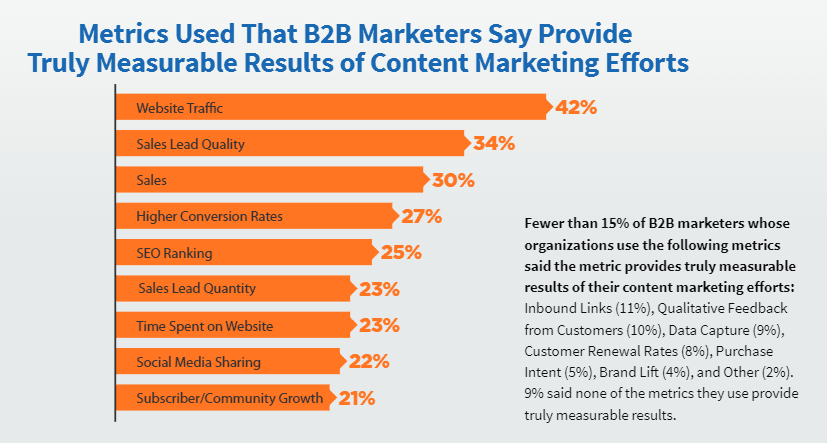
img6

Content marketers have been using website traffic as a metric to measure results of their content marketing efforts, but they’ve also been paying attention to sales, the quality of those sales leads, and conversion rates. You could argue that it’s strange to see how few marketers cited higher conversion rates or even SEO rankings as a metric. Nevertheless, it’s interesting to see that despite social media content being one of the top tactics being used, only 22% are using social media sharing as a metric of measure.

Marketing trends come and go, but paying attention to what we’ve been doing as content marketers is the only way to adjust course when we notice patterns that really aren’t optimizing tactics that work.

Download free e-book - Content Marketing 101

Read more

Digital Summit Philadelphia 2016 Recap


Digital Summit Philadelphia, from August 23 – 24, was packed with dozens of speakers, including digital marketing experts, CEOs, data scientists, SEO gurus, business owners, and even a comedian. Five members of the  EZMarketing team ventured to the two-day event and learned far more than can be written in a single blog post – but we wanted to take the time to share some key takeaways from the many sessions we attended in our Digital Summit Philadelphia 2016 recap.

Read more

5 Things to Ask Your SEO Company

 As Search Engine Optimization continues to evolve, so to should the services of any SEO company worth its salt. From Panda to Penguin, the eradication of poor quality content and spam links was only the beginning.

Newer changes like machine learning in the form of RankBrain and major Google AdWords updates continue to shake-up SEO marketing. Even the most minor changes can cause ripples in the SEO industry, leaving professionals with a need adjust their tactics in order to stay relevant.

With every algorithm update and change to Google’s advertising platforms, SEOs need to keep on their toes to stay ahead. If an SEO doesn’t evolve, neither can their business.

As a business owner, you expect your prospective (or current) SEO company to be an industry expert. You want a team full of knowledgeable people committed to staying ahead of the SEO marketing curve. Even more than their knowledge and experience, you want to be able to trust your SEO company to do what’s right for your individual business needs.

To see the most return on your investment and partner with the right team, here are some things you should always ask your SEO company:

1. How will you improve my rankings?

This question is by far the most important, and complicated, to ask your SEO company. If you’re interviewing a good SEO company, there should be no easy answer to this question. Because of its complexity, it’s best to ask it right out of the gate.

search-rankings

The best SEO company will not shy away from the question, while a less than desirable company may try to distract you with irrelevant data or industry jargon that’s simply not important at this stage in the game. They should have no problem walking you through their process – preferably with an easy-to-understand guide.

If you’re posing this question to your current SEO company, the same rules apply. They should be confident in their response and able to supply the data you need to support their choice in tactics.

2. Do you guarantee rankings?

If the first question didn’t weed out the SEO snake oil salesmen, this one surely will. Always ask your SEO company if they guarantee rankings. If they say “yes,” the conversation should end there. While guaranteed rankings might seem like a good thing, they’re an outdated SEO marketing practice that no respectable SEO company will stand by in 2016.

With algorithm changes and platform updates, rankings are hardly ever stable. It’s natural for your rankings to fluctuate a few positions day-to-day. The right SEO company understands the natural ebb and flow of rankings and won’t guarantee anything.

What they should do instead is assure you that their processes are proven to improve rankings, optimize your site, and bring you quality traffic. Modern SEO marketing is less about rankings and more about attracting qualified, ready-to-buy leads to your site. This is what you should want from your SEO marketing efforts instead of a guarantee.

3. What are your certifications?

Once you feel comfortable with the high-level view your SEO company gave you of their processes, it’s time to nail down their experience. You’ll find SEOs that have been in the industry for 20 years, and those that are relatively new. While years of experience can be an advantage, you want to ask about certifications.

google-partner

An SEO company that has taken the time to learn new material and take a series of tests to prove their knowledge is one you want. This proves that they’re willing to do the work it takes to expand their skills, making them an expert in their industry.

SEOs that take the necessary time to complete and renew their certifications are usually up-to-date with the most current search trends. Look for an SEO company that is Google Analytics and AdWords certified, and is a Google Partner. Other certifications like Hubspot Inbound, Content Marketing Institute, and DistilledU are icing on the cake.

4. Do you need to make changes to my website?

A good SEO company will have on-page changes as some part of their SEO process. The best SEO company will have a set-up process that clearly outlines any frontend and backend changes they need to make to your site, and why these changes need to happen. If these on-page changes aren’t scheduled into their process within the first month of service, they’re not the right company for you.

On-page changes set the stage for an SEO marketing campaign – that’s why they should be done before any other SEO efforts begin. These changes help address any technical issues that may be negatively affecting your site, getting it up to Google’s standards. You should also expect help with content optimization for important keywords, and even ways to improve your user experience.

It’s so important to ask your SEO company about the changes they want to make to your site before you give them any sensitive information like website logins and FTP credentials. Changes will most likely need to happen on a server or database level and an SEO company that is inexperienced with backend changes can seriously damage your site.

5. Can you provide case studies, references, and testimonials?

After you have a good idea of the company’s SEO processes and experience, it’s a good time to ask for some tangible data. Your SEO company should have a wealth of educational material and case studies that are used to back-up their good work. If the company doesn’t have any current case studies, that should be a red flag.

reviews

Case studies are important to look at because in most cases, data doesn’t lie. When you can see true clients with real traffic and ranking improvements, you can better understand the SEO company’s worth.

Aside from case studies, references and testimonials or reviews are the best way to hear about the company from a previous client’s position. While a company can make themselves look good by choosing the best case study, their clients will be honest. As in most things, the best way to find out if something worked is to ask a person who has used it before.

Adding SEO marketing to your digital marketing strategy can make or break your site. While a successful SEO marketing campaign can double your traffic and sales in some cases, a bad campaign can tank your site’s rankings. Very few online business can afford a manual penalty brought on by shady SEO practices.

Protect yourself and your assets by asking these questions before signing up with an SEO company. When you find a company that can answer these to your satisfaction, you’ll know you’ve found your search partner.

SEO strategies CTA

Read more

Categories SEO

Examples of Integrating Marketing Channels


Most companies try all different sorts of marketing tactics to obtain more leads and business. But a lot of those companies don’t know exactly what is working or how to integrate their marketing channels so that their brand message and marketing is, for the most part, consistent and tracked. Different channels can use different messaging, but your brand story should be consistent throughout.

Read more

Tactics for Tracking Your Marketing ROI


What’s the return on investment of a phone call? A form fill? An email click-through? In the age of data, using tracking tools to monitor and record your lead sources and determine the dollar value of every conversion—that is, every action a prospect takes—is easier than ever. Let’s take a look at some of the things you should be measuring, and how to track them.

Phone call tracking

i0q6

When someone calls your business, it stands to reason that they found your number somehow, whether through word of mouth, a Google search, eventhe Yellow Pages (yes, they still exist). Determining how they found you is a critical step in determining whether the marketing effort you employed that ultimately resulted in the lead was worth your money.

Using a unique phone number for each campaign—PPC marketing, email, billboards, your website design—allows call tracking software to determine where your leads are coming from. This allows you to ramp up or dial down campaigns as needed and focus your valuable marketing budget where you know it’ll have the greatest impact.

Custom link tracking

Custom URL parameters are an incredibly easy way to track the success of everything from your direct mail pieces to your social media campaigns. If the term “custom URL parameters” scares you, take a breath—it’s not nearly as difficult as it sounds.

When you integrate your site with Google Analytics, you create the rules by which your data is tracked. In doing so, you’re able to effectively monitor the lead sources of traffic to specific pages of your website, including direct traffic, search engines, referring sites, social media leads, and more. Again, when you learn the channels that drive targeted traffic, and measure which of those leads convert over time, you’re able to put more money and effort into the campaigns that work best for you.

Unique landing pages

When you run an ad campaign, where are you attempting to drive traffic? Sure, you want visitors to go to your www., but unique landing pages for each campaign allows you to do a couple great things.

First, it allows you to track your lead sources (which at this point, should be a given). But it also allows you to create highly targeted messaging leading to a call to action. Special offers, coupons, and discounts on your landing pages may result in increased conversions. As Unbounce says, “Targeted promotion or product specific landing pages are focused on a single objective that matches the intent of the ad that your visitors clicked on to reach your page.”

Custom forms


We’re not going to say that every page of your website needs a form, but if we’re being realistic about conversions, most should. Long gone are the days when a simple email address to contact was the best way to 

p1a37

solicit customer questions and feedback. With contact forms, you can collect data about the type of people who want to know more about your business, and store their IP addresses so that you’ll know when they return.

Form-fills should also factor heavily into your content marketing strategy. Provide value to your customers for free—the only thing they’re required to give you is an email address so that you can keep in touch. (If you’re not using forms as a part of your content marketing strategy, or if you’re not doing any content marketing at all, read up on making this incredibly valuable marketing approach work for you.)

So much data to track

Think about all of your marketing campaigns—email, PPC, direct mail, social media, even billboards or the brochures you might distribute for a special event. Every single person that takes an action as a result of these activities is a data point. When you view them as such, and when you’re confident about the pool of data you’ve gathered, you can ensure that the money you spend on your marketing is invested rather than wasted.

And with a limited marketing budget, every dollar that marks a return on your investment is critical. Our marketing company in Lancaster, PA can help you get your arms around your marketing efforts and track how that investment is paying off for you.


Start A Conversation

Read more